
Learning to read simple words is an exciting milestone for young learners. One of the best places to start is with CVC words, or consonant-vowel-consonant words. These short, easy-to-sound-out words help children practice letter sounds, blending, decoding, and early spelling skills.
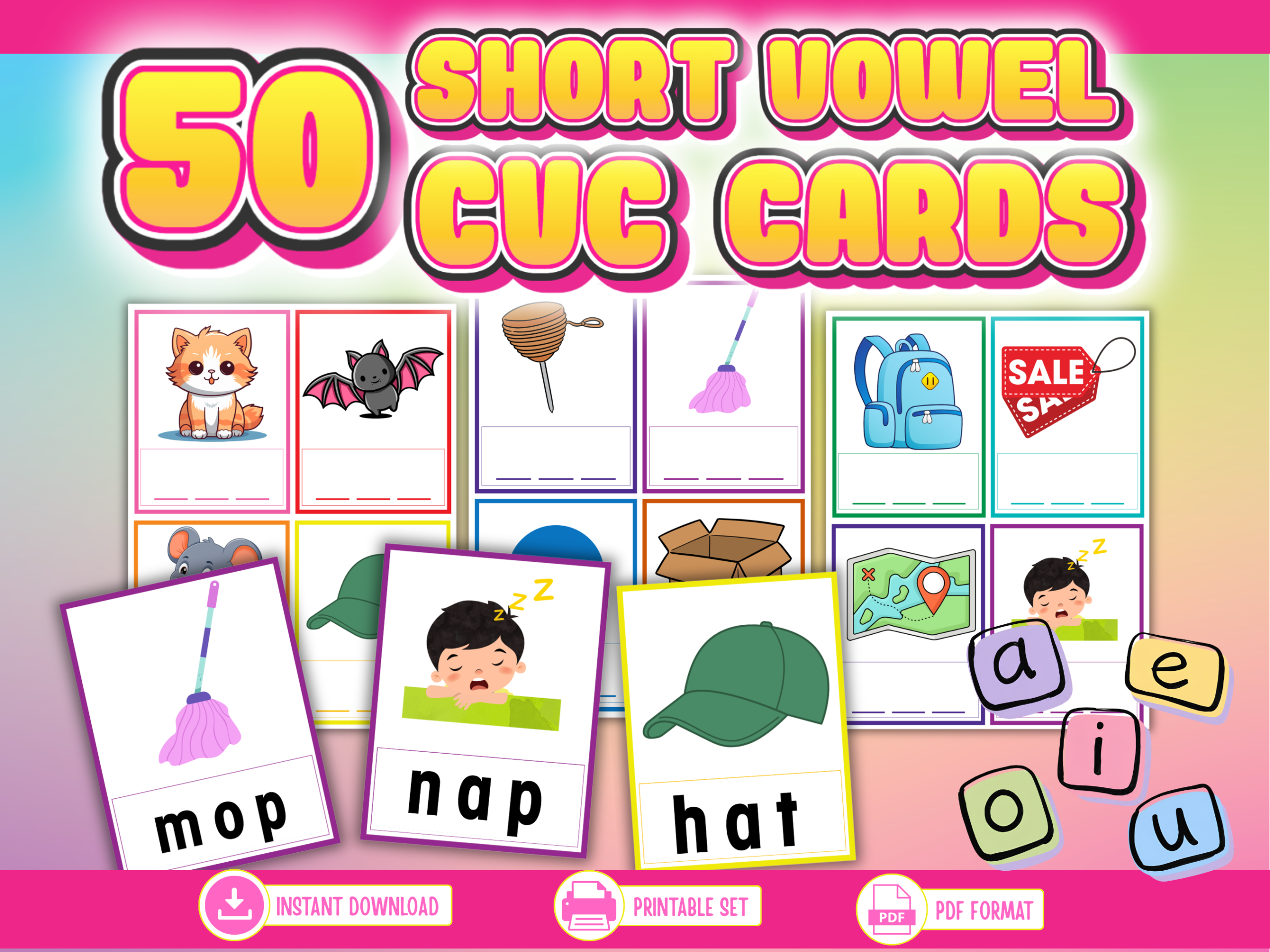
Our 50 Short Vowel CVC Word Cards Printable provides a colorful, hands-on way for preschoolers, kindergarten students, homeschoolers, and beginning readers to practice CVC words featuring short A, E, I, O, and U sounds.
What Are CVC Words?
CVC words are simple three-letter words made with a consonant, followed by a vowel, followed by another consonant.
Examples include:
C-A-T = cat
D-O-G = dog
P-I-G = pig
S-U-N = sun
Because of their simple structure, CVC words are often among the first words children learn to decode independently.
Practicing these words can help children understand how individual letter sounds blend together to create complete words.
Practice All Five Short Vowel Sounds
These printable CVC picture cards provide opportunities to practice words containing all five short vowel sounds.
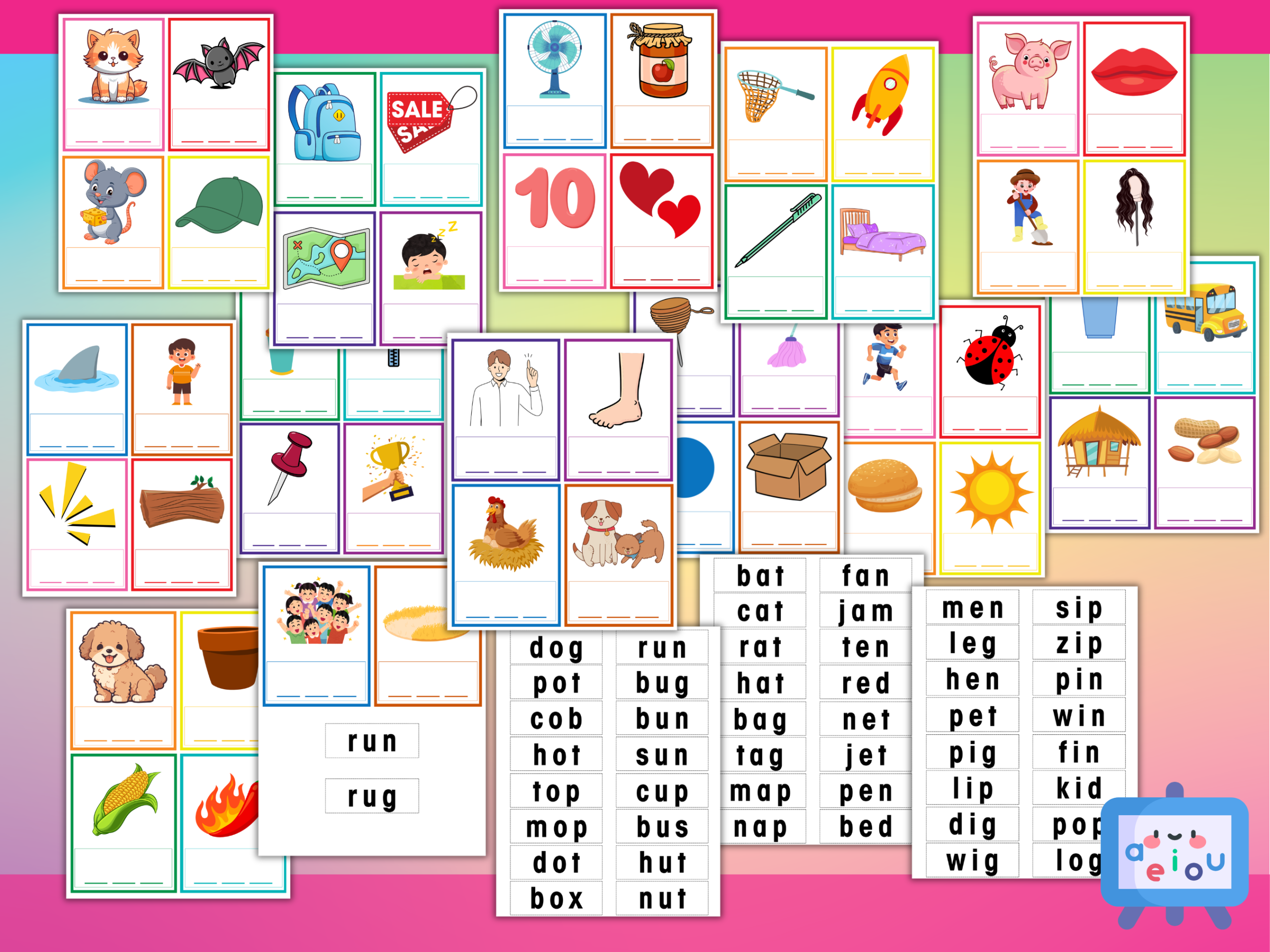
Children can work with short A words such as cat, bat, hat, and map, short E words such as hen, leg, red, and pen, short I words such as pig, lip, pin, and fin, short O words such as dog, pot, hot, and mop, and short U words such as run, bug, sun, and cup.
Mix the cards together for additional practice or separate them by vowel sound when introducing one short vowel at a time.
Picture Cards Make Phonics Practice More Engaging
Each card includes a colorful picture prompt that helps young children identify the word they are trying to sound out.
For example, a child might see a picture of a cat and then practice identifying each sound:
/c/ – /a/ – /t/
The child can then blend those individual sounds together to read cat.
This combination of pictures, letter sounds, and words makes the cards useful for children who are developing early phonics and decoding skills.
Fun Ways to Use CVC Word Cards
There are many ways teachers and parents can incorporate these printable cards into reading lessons.
Use them for picture and word matching, ask children to sound out each picture and find the corresponding word, sort the cards according to their middle vowel, or place them in a literacy center for independent practice.
You can also use the cards for spelling activities. Show your child a picture without revealing the answer and ask them to build the word with magnetic letters, alphabet tiles, or letter cards.
For additional practice, children can write the word on a dry-erase board after sounding it out.
Perfect for Kindergarten Literacy Centers
These CVC phonics cards can easily become part of a classroom literacy station.
Teachers can organize cards by vowel sound and introduce new sets as students progress. Children can work independently, with a partner, or in small reading groups.
Consider printing the cards on cardstock and laminating them for durability. Store each short-vowel group in a labeled container or resealable bag for quick classroom access.
CVC Activities for Homeschool Reading Practice
Homeschool families can also use these printable short vowel cards as part of daily phonics lessons.
Start with one vowel sound and a small number of cards. Once your child can confidently blend those words, gradually introduce additional vowel sounds.
As children progress, mix the cards together and ask them to identify the vowel sound in each word. This provides additional practice distinguishing between short vowel sounds.
Build Early Reading Confidence Through Practice
Learning to blend sounds takes repetition. Short, focused activities can give beginning readers opportunities to practice without making reading lessons unnecessarily complicated.
These 50 Short Vowel CVC Word Cards can be used for phonics lessons, literacy centers, homeschool activities, tutoring, reading intervention, spelling practice, and independent learning.
With colorful picture prompts and familiar three-letter words, they provide a versatile printable resource for helping young learners strengthen foundational reading skills.

Leave a Reply